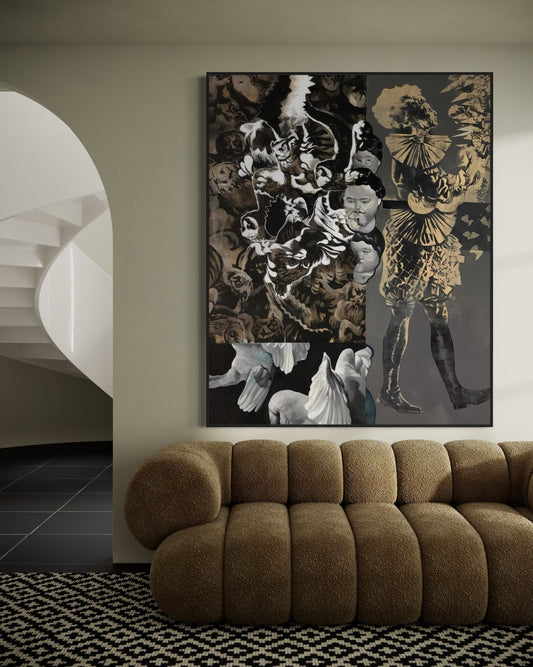
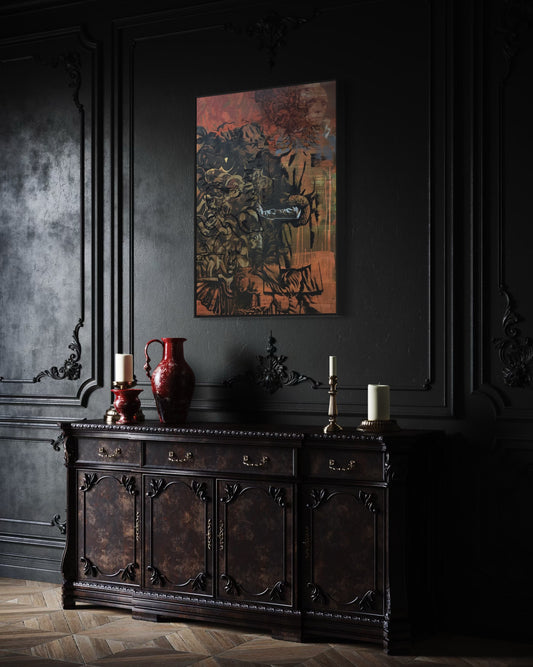
I like to view biblical stories as cultural texts containing symbolic meanings that can be explored through the lens of C.G. Jung’s depth psychology. Some time ago, I found myself returning again and again to the biblical story of the Three Kings—or, if you prefer, the Wise Men from the East.
As I tried to immerse myself in this story, I began to see it as a deeply personal one.Here we encounter a group of magi, embodiments of the “other,” the outsider, entering the court of Herod. The outsider is someone capable of perceiving the established order from an ex-centric position—that is, from outside the system itself. In this story, we see the hierarchical world of Herod, immersed in structures of power and wealth. Herod is not only a king, but also a personification of strength, splendor, and the dominance of matter over spirit; a world of entertainment, sensual pleasure, and hedonism—a world submerged in passion and content to remain there.
The visitors arrive wishing to greet the “newborn King of the Jews,” yet they are met with the terror (sic!) of Herod and his entire court. What struck me was not so much the understandable reaction of the king himself—whose power was suddenly threatened—but the reaction of everyone around him. The newcomers are attempting to overturn the established worldly order. They challenge the very foundation of values upon which this courtly world has been built. The existing structure begins to tremble. It refuses to accept the “good news,” and so the visitors are swiftly driven away from the court.
They set out into the desert, which becomes a metaphor for rejecting “this world” and stepping into darkness and emptiness.
I interpreted this part as a story of confronting one’s own spiritual identity. In it, I saw the image of a soul striving to break through the veil of illusions in which it has been living. Yet there is Light. The emptiness is not endless. Darkness does not engulf the soul completely. Somewhere on the horizon, a light flashes as a guiding point for the journey of seeking—it is the Star of Bethlehem, and beneath it, Love is born.
Thus, this entire series is a story of an unfulfilled search for Love—with a capital “L.” It is the story of a restless soul longing to nestle into the arms of the Absolute, to come to rest at the source of its own identity.
I do not know who—or what—God is. Is God a personal presence? A force? An energy permeating the world? Or perhaps a spring that wells up from the deepest layers of my own being?
I remain alone with this question, accompanied by the Wise Men from the East, who have not yet found what they seek, because they are still on the journey.


 Sold outSold out
 Sold outSold out
 Sold outSold out
 Sold outSold out