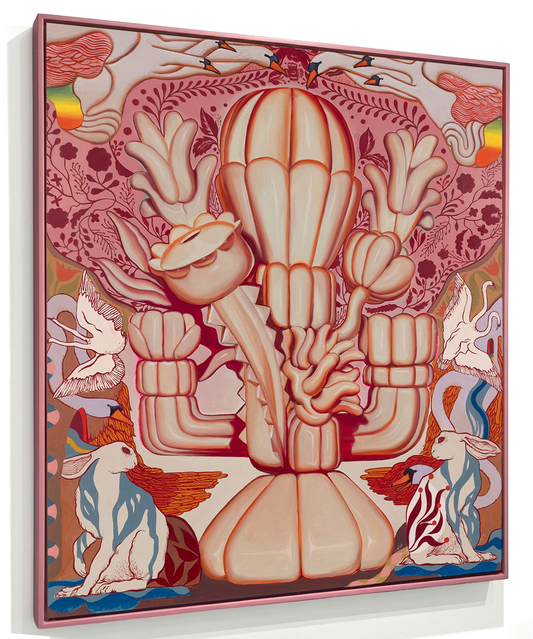
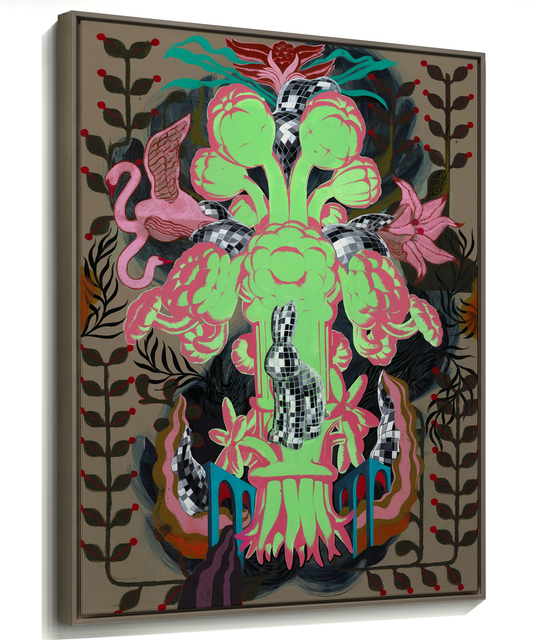
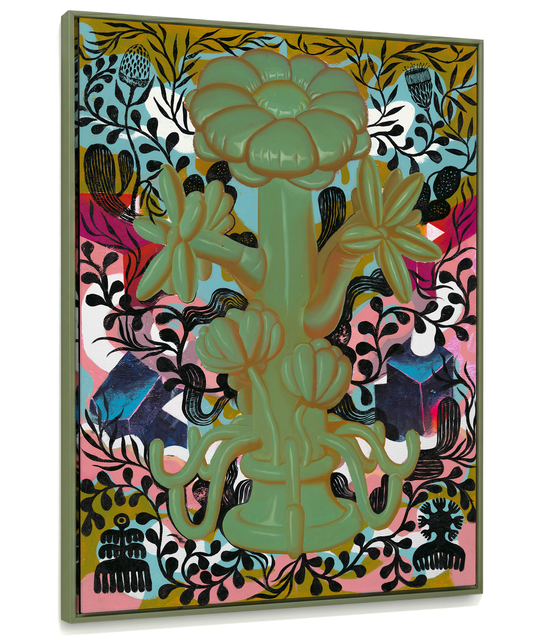
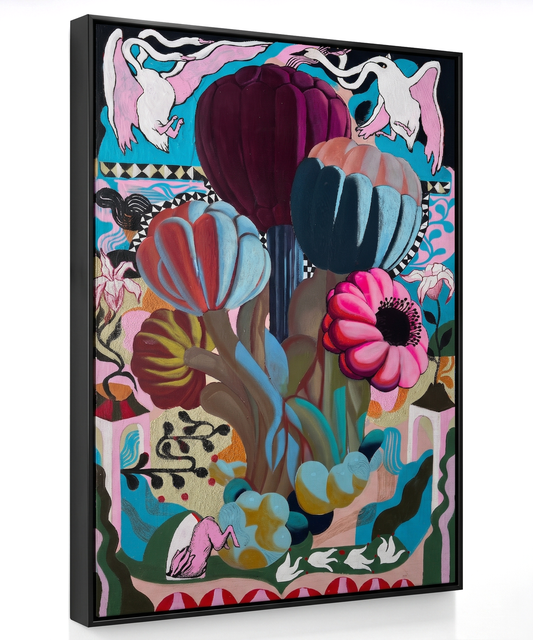
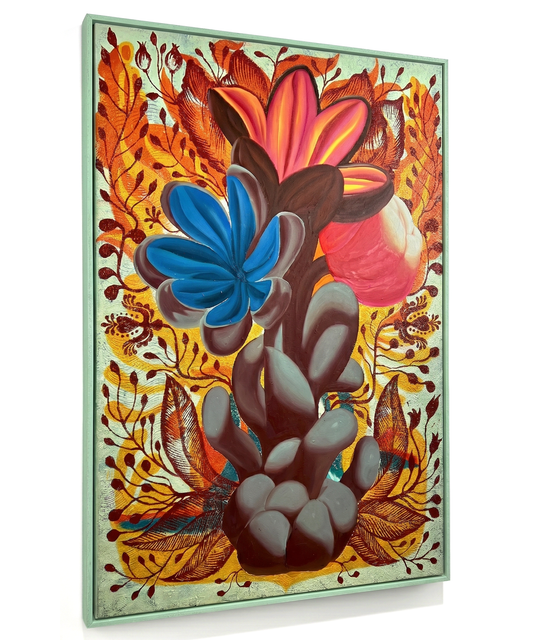
The totem has a long history, rooted in distant times. It was an object that helped organize the life of early communities. Most often, it took the form of poles or sculptures placed at the center of village life. It appeared in various shapes and colors. Its primary function, however, was to establish and uphold the values that governed a given community, often one that was hermetic and inward-looking. In this sense, it served as the Axis Mundi—the axis of a local world. It upheld the heavens, protecting the community from a catastrophic collapse. Just as a coherent and predictable world can only exist when supported by an ordered system of values.
The subject of this series is an attempt to revisit and reinterpret this symbol. In my paintings, I transform the totem into something fragile and temporary—objects that appear inflated, almost like inflatable toys, or forms that can be placed anywhere at will. Through this transformation, I reflect on the fluid nature of contemporary values: “instant” values that can be selected, exchanged, and rearranged according to personal preference. Ultimately, this is a meditation on a changing axiology that turns the totem into a personal object—something indivisible, no longer functioning as a social bond, but instead becoming a marker of identity for an individual or a small group arbitrarily united by a particular set of beliefs.
On a purely visual level, I found the theme of the totem immensely compelling. It offers a space for experimentation with color and ornament. Yet the most intriguing aspect was the possibility of creating an entire family of totems and observing how they relate to one another—whether they can enter into dialogue at all. Or are they, by their very nature, “autistic objects,” isolated from everything around them, thereby confirming the essence of what they are?
An integral element of the symbolism woven into these paintings is the figure of the swan. It appears in various forms—with two heads, multiple wings, or arranged in anatomically impossible configurations. These distortions serve as a way of reflecting on its nature. For can a swan with three wings truly take flight? Have the laws of physics and aerodynamics not shaped it into the form we know? These questions are not really about the swan itself, but about the constraints imposed by nature. Does nature leave certain things undefined, while simultaneously setting boundaries that cannot be crossed—even when culture seeks to challenge and transcend them?
The series therefore becomes an inquiry into whether a totem can truly be placed anywhere, in any context. Or whether it ultimately has its own limitations and remains bound to convention. Yet no longer at the center of communal life; instead, it occupies the peripheries—in private corners where dialogue becomes fragmented, opaque, and at times impossible.